SHENZHEN, GUANGDONG, CHINA, September 24, 2026 /EINPresswire.com/ — Industrial automation relies on interactive visual displays to monitor assembly lines, control robotic workstations, and manage supervisory control and data acquisition (SCADA) systems. Sourcing from an industrial LCD monitor supplier requires evaluating hardware resilience, interface versatility, mechanical mounting flexibility, and long-term supply continuity. Standard commercial office monitors quickly fail in factory environments, where airborne oil mist, chemical washdowns, mechanical vibration, and electrical noise cause component breakdown. Automation engineers must establish clear technical criteria to select display hardware that delivers dependable 24/7 performance.
Identify the Specific Automation Environment First
Successful automation display integration begins with a thorough evaluation of the operating environment. Industrial automation terminals operate across diverse physical environments, from clean pharmaceutical packaging suites to heavy metal stamping facilities. Establishing environmental specifications requires analyzing operating temperature ranges, moisture levels, chemical exposure profiles, and physical impact risks.
Industrial-grade LCD monitors support an operating temperature envelope of -20°C to 70°C and non-condensing relative humidity up to 90%. In outdoor or unconditioned factory floors, wide-temperature LCD panels prevent sluggish liquid crystal response at freezing temperatures and avoid display clearing effects under extreme heat. Rigid internal component anchoring prevents loose connectors during continuous machinery vibration.
Front-panel ingress protection rated at IP65 prevents water spray, cutting fluids, and airborne dust from penetrating the monitor enclosure during routine washdowns. Chemically strengthened front cover glass achieving IK08 impact resistance protects against dropped tools and mechanical impacts, while chemically etched anti-glare surfaces preserve optical clarity despite repeated exposure to industrial cleaning detergents.
Select Touch Physics for Industrial WorkflowsProjected Capacitive Multi-Touch for Modern HMIs
Matching touch digitizer technology to operator workflow requirements is essential for factory productivity. Projected capacitive (PCAP) sensing is the standard choice for modern multi-touch HMIs, offering smooth gesture control, optical clarity, and flat-front glass integration that simplifies cleaning.
Advanced PCAP controllers feature dynamic firmware threshold tuning that distinguishes between intentional operator touches and surface fluid droplets. Mutual-capacitance electrode grids track up to ten concurrent touch points, maintaining coordinate accuracy even when the screen is coated with water or light oil films.
Five-Wire Resistive Sensing for Heavy Gloved Workstations
For workstations where operators wear heavy insulated leather gloves, rubber chemical mittens, or use non-conductive tools, 5-wire resistive touch screens provide consistent actuation reliability. Because resistive sensing relies purely on mechanical pressure, it operates unaffected by airborne conductive dust, grease films, or surface liquid puddles. In five-wire resistive construction, all electrical excitation voltage networks reside permanently on the rigid glass base, while the flexible upper membrane functions strictly as a passive voltage sensor, enduring over 35 million touches in demanding industrial use.
Verify Display Luminance and Optical Treatments
Factory lighting environments present significant visual challenges. Overhead high-bay metal halide lighting, bright LED spotlights, and sunlight from factory skylights wash out display contrast and create blinding surface glare. An industrial automation touch monitor requires high-brightness LED backlights rated from 400 to 1,000 nits or higher, paired with chemically etched anti-glare (AG) surface treatments that diffuse specular reflections.
Direct optical bonding between the cover glass and LCD panel permanently eliminates internal air gaps. Optical bonding eliminates internal light reflections, prevents internal condensation in unconditioned plants, and enhances visual contrast ratios for crisp graphic rendering. Industrial LED backlights incorporate solid-state thermal management that guarantees operational half-life (L70) exceeding 50,000 continuous hours.
This longevity ensures that screen luminance remains stable over five to seven years of uninterrupted 24/7 service. Pulse-width modulation (PWM) backlight dimming circuitry provides wide brightness adjustment from 100% down to 10% or lower, preventing operator eye fatigue during nighttime plant shifts while preserving accurate color rendering across all brightness settings.
Standardize Interface Connectivity and Power Architecture
Industrial displays interface with diverse computing hardware, from modern industrial PCs to legacy programmable logic controllers (PLCs). Standardizing factory display interfaces simplifies installation and spare parts inventory. Video inputs include modern digital HDMI and DisplayPort connections alongside legacy analog VGA ports. Touch coordinate telemetry relies primarily on universal driverless USB 2.0 HID protocols, supplemented by RS-232 serial ports for legacy industrial operating systems.
Industrial power buses frequently suffer from voltage dips, switching surges, and transient inductive spikes from heavy machinery. Specifying monitors with wide-voltage DC power inputs (such as 9V to 36V DC) coupled with integrated over-voltage, reverse-polarity, and transient surge suppression ensures uninterrupted continuous operation, isolating sensitive timing controllers from industrial line noise.
Evaluate Mechanical Mounting and Cabinet Sealing
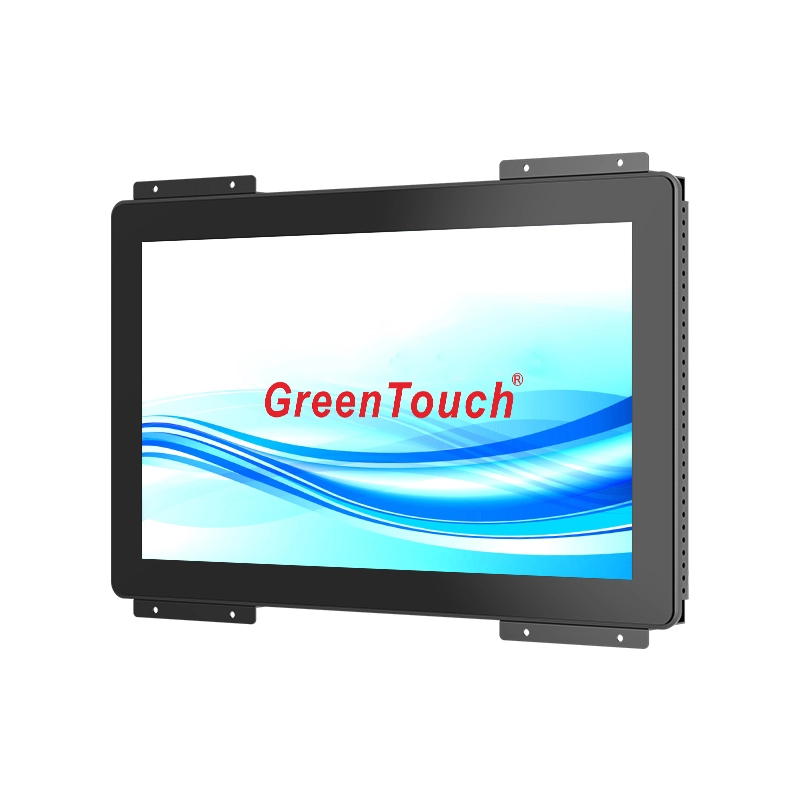
Industrial monitor mounting architectures provide adaptable physical mounting across automated machinery consoles, swing arms, and control cabinets. Panel-mount designs utilize heavy-duty rear clamping brackets that pull the monitor front bezel firmly against cabinet cutouts, compressing closed-cell silicone gaskets to achieve front IP65 dust and water sealing. Open-frame chassis incorporate perimeter side brackets that secure behind custom enclosure cutouts, creating a seamless flush-front exterior aesthetic.
Standardized rear VESA mounting holes (75×75 mm and 100×100 mm) permit direct installation onto articulated operator swing arms, desktop pedestals, and equipment racks. Rigid aluminum or galvanized steel chassis isolate sensitive display components from cabinet mechanical flex.
High-tensile steel mounting studs ensure that the elastomeric seal maintains continuous watertight integrity despite ambient thermal expansion cycles. Heavy-duty panel-mount clamps incorporate Belleville spring washers that maintain constant gasket compression, ensuring that the front IP65 seal remains watertight during rapid ambient temperature transitions.
Audit Quality Standards and Factory Continuity
Automation programs require multi-year hardware availability and strict revision management. Within our precision fabrication plant in Shenzhen, GreenTouch enforces dual ISO 9001 and ISO 14001 quality frameworks. Industrial-grade LCD panels are paired with backlight LEDs rated for 50,000 continuous operating hours, securing long-term supply stability.
Strict engineering change order (ECO) protocols guarantee that replacement monitors maintain identical cutouts, mounting patterns, and connector pinouts across multi-year automation deployments. Incoming raw component screening and 24-hour burn-in cycling ensure that early component failures are eliminated before final shipment.
FAQ about Industrial LCD Monitor Sourcing
Automation system integrators and equipment designers regularly evaluate these core procurement factors.
What Temperature Range Is Required for Industrial Automation Monitors?
Industrial-grade monitors require an operating temperature envelope of -20°C to 70°C, maintaining crisp optical response and preventing liquid crystal blackening in unconditioned manufacturing facilities.
How Does Fanless Architecture Enhance Industrial Monitor Reliability?
Fanless designs utilize conduction-cooled aluminum chassis to dissipate internal heat silently. Eliminating cooling fans prevents airborne metal dust, oil mists, and textile fibers from entering the enclosure, significantly increasing MTBF.
Can Touch Controllers Be Calibrated for Thick Industrial Work Gloves?
Yes. Industrial PCAP controllers feature firmware baseline threshold tuning that supports smooth actuation through heavy work gloves up to 3 mm or 5 mm thick without false triggers.
Review Automation Display Criteria with GreenTouch
Optimizing industrial display selection requires early collaboration between automation engineers and display specialists. Harmonizing mounting geometries, interface connectivity, optical treatments, and environmental sealing ensures reliable factory floor operation. Automation machine builders, plant engineers, and systems integrators are invited to share their technical specifications directly at https://www.greentouch.com.cn/ for detailed evaluation. Our engineering team provides comprehensive customization support, verified environmental testing, and dependable long-term supply continuity for industrial programs.
ShenZhen GreenTouch Technology Co.,Ltd.
GreenTouch
email us here
Visit us on social media:
LinkedIn
Facebook
YouTube
Legal Disclaimer:
EIN Presswire provides this news content “as is” without warranty of any kind. We do not accept any responsibility or liability
for the accuracy, content, images, videos, licenses, completeness, legality, or reliability of the information contained in this
article. If you have any complaints or copyright issues related to this article, kindly contact the author above.

Media gallery